
How to Choose the Right Indian Spices for
Date: 17 November 2026

Buying spices online is convenient, but overlooking product details can lead to disappointing purchases. From judging quality by product photos to ignoring ingredient information, manufacturing dates, and customer reviews, small mistakes can affect your shopping experience. Learn what to watch for before placing an order and how to make more informed choices.
Online shopping has made it easier to explore different Indian spices and masalas without visiting a physical store. However, buying spices online comes with a challenge: you cannot directly smell, touch, or examine the product before ordering it.
A colourful product image, an attractive discount, or a high customer rating may influence your decision, but these details do not always tell the complete story. Important information can be overlooked when you shop in a hurry.
If you want a broader overview of the selection process, our guide to buying spices online provides additional context. This article takes a different approach by focusing on common mistakes, misleading assumptions, and overlooked details that can affect your purchasing decisions.
One common mistake when buying spices online is assuming that a product’s appearance tells you everything about its quality.
A photograph may show bright red chilli powder, golden turmeric, or a richly coloured masala blend. However, lighting, image editing, and screen settings can influence how these colours appear. A visually appealing photograph does not prove that a spice is fresh, authentic, or free from unwanted ingredients.
For example, two turmeric powders may look almost identical in product photographs but have different ingredient information, processing methods, or storage histories.
How to avoid this mistake:
Remember that photographs cannot reliably establish a spice’s purity or chemical composition.
A product title is designed to identify an item quickly, but it may not provide every detail you need before ordering.
For example, a shopper looking for cumin might accidentally select a different product format or overlook the quantity mentioned in the listing. Similarly, a masala blend may contain several spices, whereas a single-ingredient spice generally lists one principal ingredient.
These differences matter because the product you receive should match your cooking needs and expectations.
Another potential mistake is assuming that words such as “premium,” “traditional,” or “natural” automatically explain what a product contains.
How to avoid this mistake:
Do not rely on the product title alone when the full listing contains information that could affect your purchase.
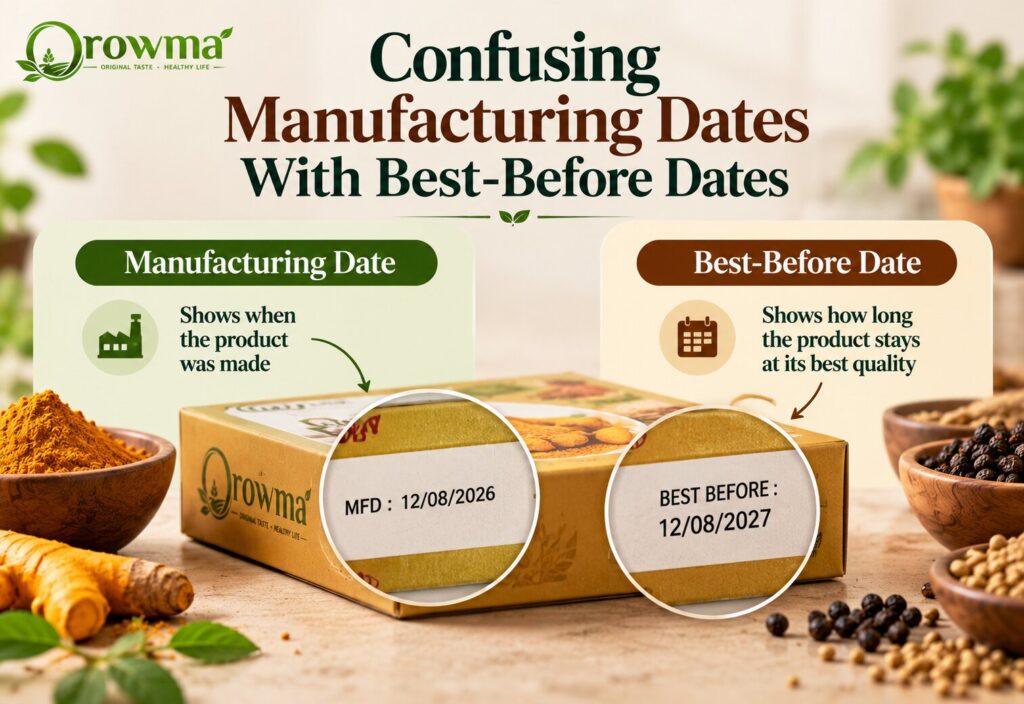
Manufacturing dates and best-before dates serve different purposes, yet shoppers sometimes confuse them when reviewing product information.
The manufacturing or packing date indicates when the product was manufactured or packed, as applicable. The best-before date generally indicates the period during which the product is expected to retain its intended quality under the specified storage conditions.
Spices can gradually lose aroma and flavour during storage. Heat, moisture, air exposure, and unsuitable storage conditions can influence their quality.
However, an older manufacturing date does not automatically mean that a product is unsafe or unusable. The applicable date information, packaging condition, storage requirements, and product instructions all matter.
How to avoid this mistake:
If essential information is unclear, contact the seller before purchasing rather than making assumptions.
Customer reviews can be useful when choosing spices online, but relying entirely on a star rating is another common mistake.
A product with a high average rating may still receive mixed feedback about aroma, flavour, packaging, quantity, or delivery. Conversely, a negative review might describe a delayed shipment rather than a problem with the spice itself.
The most useful reviews often explain what the customer experienced rather than simply saying that a product was good or bad.
For instance, a detailed review describing how a garam masala performed in a curry may offer more relevant information than a one-line comment with five stars.
How to avoid this mistake:
Reviews should help you understand other customers’ experiences, not serve as a guarantee of future product quality.
An attractive discount can make a spice product appear to be a bargain. However, the displayed price alone may not tell you whether you are getting good value.
Imagine two hypothetical coriander powder listings. One costs ₹60 for 100 g, while another costs ₹90 for 200 g. Although the second listing has a higher price, it costs less per gram.
The comparison still needs context: the products should be reasonably comparable in terms of ingredients, quantity, packaging, and other relevant details.
You should also consider applicable delivery charges and the final payable amount.
How to avoid this mistake:
A lower price does not automatically mean poor quality, just as a higher price does not guarantee superior quality.
Sometimes shoppers focus so much on the product that they overlook the seller and the terms of the purchase.
Important details may include contact information, delivery timelines, shipping charges, and return or refund conditions. If these details are missing or unclear, resolving a problem after ordering may become more difficult.
It is also important to distinguish between information that is genuinely available and assumptions based on a website’s appearance. A professional design or attractive product photography cannot independently establish a seller’s reliability.
For packaged food products, relevant manufacturer, seller, and food-business information can provide additional context, depending on the product and applicable requirements.
For additional information about food safety and applicable food regulations in India, consumers can consult the official Food Safety and Standards Authority of India (FSSAI) website.
How to avoid this mistake:
A little research before payment can help you make a more informed purchase and understand what to expect if something goes wrong.
Words such as “pure,” “natural,” “authentic,” and “premium” are common in spice marketing. Although these descriptions may communicate a seller’s positioning, the words alone are not conclusive proof of a product’s composition or quality.
For example, a listing may describe a spice as natural without providing enough information for you to independently verify every aspect of its processing or composition.
To understand this distinction in more detail, see our related guide on how to check spice purity at home. It provides additional context on evaluating spices, while remembering that simple home checks cannot conclusively establish chemical purity or detect every adulterant.
How to avoid this mistake:
Informed shopping means considering the available evidence rather than accepting or rejecting a product based on marketing words alone.
Before completing your next online spice order, take a moment to check:
These simple checks can help you avoid common purchasing errors without making online shopping unnecessarily complicated.
Buying spices online can be convenient when you know which details deserve attention. Avoid judging products by photographs alone, overlooking ingredient information, relying entirely on star ratings, or accepting marketing claims without considering the available evidence. Checking product details, dates, packaging, seller information, and total cost can help you make more informed decisions. Whether you are stocking everyday kitchen essentials or exploring new masalas, take a moment to review the information before ordering. Explore Orowma’s range of spices and masalas to find products that suit your cooking needs.

Common mistakes include judging quality by product photographs, overlooking ingredients and quantity, misunderstanding date labels, relying only on star ratings, ignoring delivery charges, and accepting marketing claims without evaluating the available product information.
No. Product photographs can be affected by lighting, editing, and screen settings. Colour alone cannot reliably establish freshness, authenticity, or purity. Check the ingredient list, product description, and other relevant details before purchasing.
Customer reviews can provide useful feedback about aroma, flavour, packaging, quantity, and delivery. Reading several detailed reviews helps you identify recurring experiences instead of relying on a single comment or the overall star rating.
A manufacturing or packing date indicates when a product was manufactured or packed, as applicable. A best-before date generally indicates its expected quality period under specified storage conditions. Always follow the product's date labels and storage instructions.
No. Product descriptions can provide important information about ingredients, sourcing, and processing, but they cannot independently establish every aspect of purity or authenticity. Consider the available supporting information and seek clarification about claims that matter to your purchase.
At Orowma, we bring authentic Indian flavors to your kitchen with carefully crafted spices and masalas. Made using traditional recipes and quality ingredients, our range includes spice powders, blended masalas, and whole
Get Started Now
Date: 17 November 2026
Date: 11 November 2026
Date: 07 November 2026
We use cookies to improve your browsing experience, analyze website traffic, and provide essential website functionality. You can accept all cookies, reject non-essential cookies, or manage your preferences.
Manage your cookie preferences. You can enable or disable different categories of cookies below.
Essential cookies enable basic functions and are necessary for the proper function of the website.
Marketing cookies are used to follow visitors to websites. The intention is to show ads that are relevant and engaging to the individual user.
Website security powered by MilesWeb
Login to continue to Orowma
Join Orowma today
Enter the 6-digit code sent to your email.