
What Is Chaat Masala? Ingredients, Flavor, and Common
Date: 30 October 2026
Why spices lose flavor comes down to the gradual loss of essential oils that give spices their aroma and taste. Heat, moisture, sunlight, and air can speed up this process, while ground spices usually lose their potency faster than whole spices. Proper storage can help preserve spice freshness for longer. Keep spices in airtight containers and store them in a cool, dry, dark place away from heat and sunlight. Buying smaller quantities and grinding whole spices in small batches can also help maintain better aroma, flavor, and overall spice quality.
Open an old spice jar and give it a sniff — chances are, it smells like almost nothing. That faded aroma isn’t your imagination. Spices are living, chemically active ingredients, and the same compounds that give them their punch are also the first to disappear. Understanding why spices lose flavor helps you shop smarter, cook better, and stop wasting money on jars that add little more than color to your food. In this article, we’ll break down the science behind fading spice quality, the everyday habits that speed it up, and simple ways to protect spice freshness in your own kitchen.
Every spice owes its aroma and taste to essential oils — tiny, volatile compounds locked inside seeds, bark, roots, and pods. Cinnamon’s warmth, cumin’s earthiness, and cardamom’s sweetness all come from these oils. The problem is that “volatile” is the key word here. These compounds evaporate naturally over time, even when a jar is sealed and untouched. Grinding a spice breaks open its cell walls and exposes more surface area, which speeds up evaporation dramatically. That’s why freshly ground pepper smells sharper than pre-ground pepper that’s been sitting on a shelf for months.
This is also why whole spices generally outlast ground ones by a wide margin. If you’re deciding between the two, it’s worth reading about whole spices vs ground spices to see which suits your cooking style and how each holds up over time.
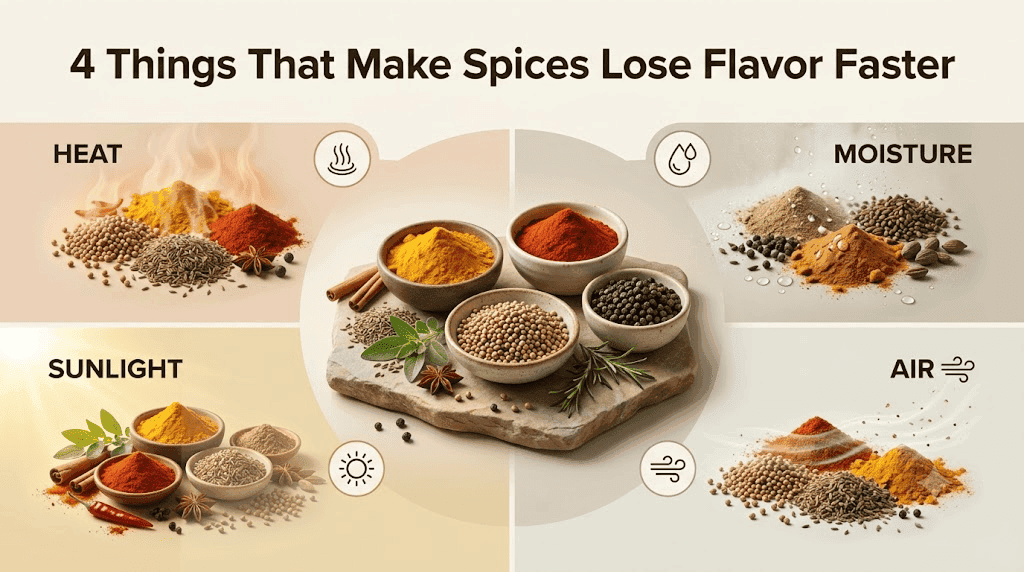
Heat accelerates the breakdown of essential oils. Storing spices near a stove, oven, or in direct sunlight-warmed cabinets quietly cooks away their potency, long before the spice looks or smells “off.” Keeping jars in a cool, shaded pantry preserves aroma far longer.
Humidity is one of the fastest ways to ruin dried spices. Moisture causes clumping, encourages mold growth, and dilutes flavor compounds. Steam from cooking pots, damp spoons dipped into jars, and kitchens near sinks are common moisture sources people overlook.
Light — especially direct sunlight — breaks down pigments and volatile oils through photodegradation. This is why a vivid red chili powder can turn dull and brownish over time. Clear glass jars displayed near windows look attractive, but they shorten shelf life considerably.
Oxygen reacts with essential oils in a slow process called oxidation, which is the same reason cut fruit browns or oil turns rancid. Every time a jar is left open or poorly sealed, more oxygen gets in, and more flavor gets out.
There’s no universal expiry date, but general shelf-life guidelines help:
These numbers assume proper storage. Poor conditions can cut shelf life in half.
These timeframes are general quality guidelines rather than strict expiration dates. Storage conditions can affect how quickly spices lose their aroma, color, and flavor. The USDA FoodKeeper guidance also notes that storage times are useful guidelines and not hard-and-fast rules.
You don’t need lab equipment — your senses are enough:
If you’re unsure whether what’s on your shelf is genuine or has been diluted with fillers, this guide on how to check spice purity at home walks through simple tests you can do yourself.
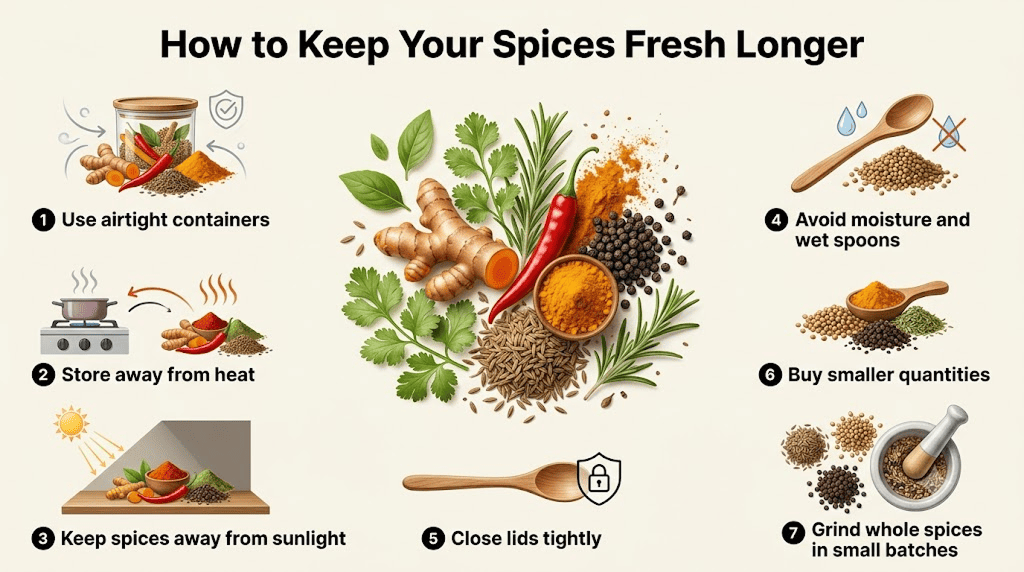
Good storage habits can add years to a spice’s usable life:
Packaging quality matters just as much as storage habits at home. Spices sealed properly at the source retain their oils far better before they even reach your kitchen — something worth checking when you buy spices online.
Freezing can slow degradation for some spices, particularly whole ones, by reducing oxidation and temperature fluctuation. However, moisture from condensation when thawing repeatedly can do more harm than good. For most home cooks, a cool, dark pantry with airtight jars remains simpler and equally effective.
Spices don’t fail suddenly — they fade quietly, pushed along by heat, moisture, sunlight, and air until their essential oils are gone. The good news is that most of this decline is preventable. Store spices in airtight containers, away from heat and light, buy whole where possible, and purchase in quantities you’ll actually use before potency drops. A little attention to storage habits, combined with sourcing genuinely fresh, well-packed spices, makes the difference between food that tastes flat and food that tastes truly alive with flavor.
Most spices don't “expire” in a way that makes them unsafe to eat. Instead, they gradually lose aroma, color, and potency, becoming less effective rather than harmful.
Grinding exposes more surface area to air, light, and heat, speeding up the evaporation of essential oils.
Yes, as long as there's no mold, unusual smell, or moisture contamination. They just may need to be used in larger quantities to achieve the same flavor impact.
Airtight glass or tin containers with tight-fitting lids, kept away from heat and light, work best for long-term freshness.
At Orowma, we bring authentic Indian flavors to your kitchen with carefully crafted spices and masalas. Made using traditional recipes and quality ingredients, our range includes spice powders, blended masalas, and whole
Get Started Now
Date: 30 October 2026
Date: 27 October 2026
Date: 25 October 2026
We use cookies to improve your browsing experience, analyze website traffic, and provide essential website functionality. You can accept all cookies, reject non-essential cookies, or manage your preferences.
Manage your cookie preferences. You can enable or disable different categories of cookies below.
Essential cookies enable basic functions and are necessary for the proper function of the website.
Marketing cookies are used to follow visitors to websites. The intention is to show ads that are relevant and engaging to the individual user.
Website security powered by MilesWeb
Login to continue to Orowma
Join Orowma today
Enter the 6-digit code sent to your email.