
What Is Chaat Masala? Ingredients, Flavor, and Common
Date: 30 October 2026

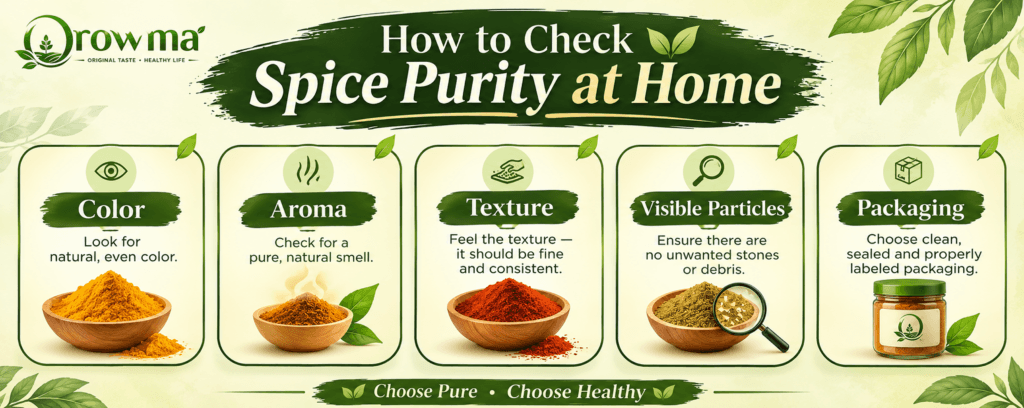
If you want to know how to check spice purity at home, there are a few simple checks you can perform using color, aroma, texture, visible particles, and packaging. Turmeric, chilli, cumin, coriander, black pepper, and other spices add flavor, aroma, and color to food. However, because many spices are sold as powders, it can be difficult to judge their quality simply by looking at them.
This raises a common question: how can you check spice purity at home?
You can perform a few simple checks based on a spice’s appearance, aroma, texture, and packaging. Some specific water-based tests can also be used to look for certain types of adulteration.
However, there is an important limitation: home tests are indicative, not definitive. Natural spices can behave differently because of their variety, processing, and particle size. A household test cannot guarantee that a spice is completely pure or confirm every possible adulterant.
For official food-safety information and guidance on food adulteration, see the Food Safety and Standards Authority of India (FSSAI).
Spice adulteration means adding an unwanted, inferior, or undeclared substance to a spice. This may be done to increase quantity, change appearance, or reduce production costs.
Some possible warning signs include:
These signs do not prove adulteration. They simply indicate that you may want to examine the product more carefully.
Turmeric naturally has a yellow to yellow-orange color and a characteristic earthy aroma.
Place a small amount of turmeric powder on a clean white plate and examine it under good lighting.
Check for:
You may also place a small amount in a transparent glass of water and observe it without vigorously stirring.
However, do not treat the water test as a definitive turmeric purity test. Natural turmeric contains pigments that can disperse in water. The result can also vary depending on how finely the turmeric is ground and how it has been processed.
Therefore, color spreading or settling behavior alone cannot tell you whether turmeric is adulterated.
For comparison, you can review the ingredients and product information provided for turmeric powder.
Red chilli powder naturally has a strong color and characteristic spicy aroma. Its exact appearance depends on the chilli variety and processing method.
Place a small amount on a clean white surface and examine:
You can also place a small amount in a transparent glass of water and observe it without vigorously stirring.
If you notice unusual particles or an unexpectedly intense color, consider it a reason to investigate further.
However, color spreading in water does not prove that chilli powder is adulterated. Natural chilli pigments can also disperse in water, and the result can vary depending on particle size and processing.
For product comparison, you can review the ingredient and product information for red chilli powder.
Whole cumin seeds are generally easier to inspect than cumin powder because their natural shape remains visible.
Take a small quantity and examine it under good lighting.
Look For:
Next, gently rub a few seeds between your fingers and smell them.
Fresh cumin should have its familiar warm, earthy aroma. A weak or unusual smell may indicate stale or poorly stored cumin. It does not automatically mean that the cumin is adulterated.
Whole cumin is also easier to inspect than cumin powder because you can see the physical characteristics of the seeds.
For product comparison, you can review the product information for cumin seeds.
Coriander powder generally has a natural greenish-brown to light brown appearance and a recognizable earthy aroma.
Place a small amount on a clean white surface and check for:
You can also observe a small quantity in water. If you notice material that looks clearly different from the spice, treat it only as a warning sign.
This is not a definitive coriander purity test. Natural spice particles can behave differently in water, so the result cannot confirm adulteration on its own.
Whole spices can often be easier to inspect than powdered spices because their natural shape and appearance remain visible.
Examples include:
When buying whole spices, check their:
Whole spices can also be ground shortly before use, which may help retain their natural aroma and freshness.
Checking the package is an important part of assessing spice quality.
Before purchasing packaged spices, look for:
Avoid products with damaged, opened, leaking, or poorly stored packaging.
If you buy spices online, check the product description, ingredients, package size, seller information, and storage instructions before ordering. This guide to buying spices online explains some factors to consider when purchasing spices online.

No. Home tests cannot reliably confirm complete spice purity.
Visual inspection, aroma, texture, and water-based observations can help identify unusual characteristics. However, these methods cannot detect every possible adulterant.
For example, a pure spice may naturally release color into water, while some adulterants may not produce an obvious visible change.
This is why a home test should be treated as a screening method, not a laboratory test.
If you need to confirm whether a spice contains a particular adulterant, appropriate laboratory analysis is necessary.
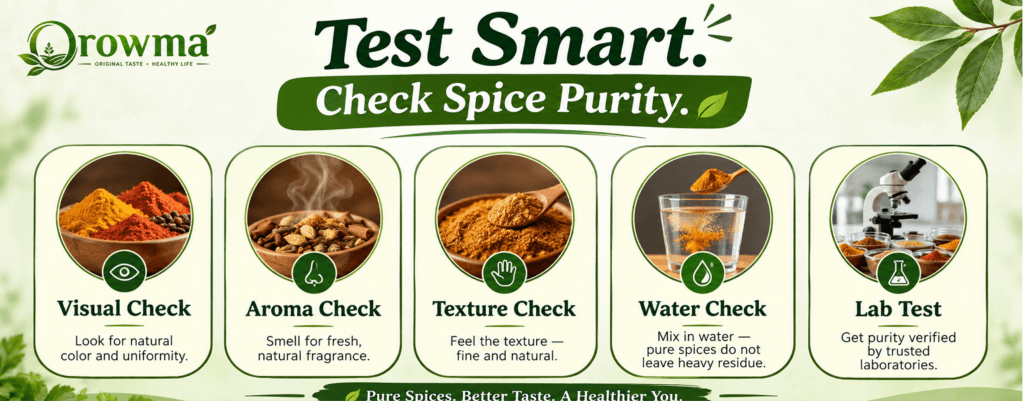
A few simple buying habits can help reduce the risk of purchasing poor-quality spices:
Whole spices can also be a practical option when you want to inspect their appearance before grinding them.
Knowing how to check spice purity at home can help you pay closer attention to the spices you buy and use. Simple checks involving appearance, aroma, texture, packaging, and appropriate household test methods can help identify possible warning signs.
The key is to interpret these tests correctly. A home water test, smell test, or visual check does not guarantee that a spice is pure. Natural spices can behave differently depending on their variety, processing, and particle size.
For everyday purchases, check the label and packaging, buy from reliable sources, and consider whole spices when practical. If you need definite confirmation of adulteration, laboratory testing is more appropriate than relying on a household test alone.

You can examine a spice's color, aroma, texture, visible particles, and packaging. Certain household tests can also be used for specific types of adulteration, but they cannot guarantee complete purity.
Start with visual and aroma checks and use an appropriate household test where applicable. These methods are preliminary checks only. Laboratory testing is needed to confirm specific adulterants.
Not necessarily. Pure turmeric naturally contains pigments that can disperse in water. Therefore, color spreading alone cannot establish that turmeric is adulterated.
No. Natural chilli pigments can also disperse in water. A water observation should not be treated as proof of adulteration.
Generally, yes. Whole cumin, coriander seeds, black pepper, and similar spices retain their natural shape and appearance, making visual inspection easier than with powdered spices.
Laboratory analysis is the appropriate method when you need to identify and confirm a specific adulterant. Home tests can only provide preliminary indications.
At Orowma, we bring authentic Indian flavors to your kitchen with carefully crafted spices and masalas. Made using traditional recipes and quality ingredients, our range includes spice powders, blended masalas, and whole
Get Started Now
Date: 30 October 2026
Date: 27 October 2026

Date: 25 October 2026
We use cookies to improve your browsing experience, analyze website traffic, and provide essential website functionality. You can accept all cookies, reject non-essential cookies, or manage your preferences.
Manage your cookie preferences. You can enable or disable different categories of cookies below.
Essential cookies enable basic functions and are necessary for the proper function of the website.
Marketing cookies are used to follow visitors to websites. The intention is to show ads that are relevant and engaging to the individual user.
Website security powered by MilesWeb
Login to continue to Orowma
Join Orowma today
Enter the 6-digit code sent to your email.